
Interview preparation
Best Books for Trading and Quantitative Finance Interviews
Last updated: Mar 24th, 2026
Breaking into proprietary trading or quantitative finance requires more than raw aptitude. Firms like IMC, Jane Street, Flow Traders, Akuna Capital, Maven Securities, and Susquehanna International Group (SIG) hire candidates who combine fast numerical thinking with a solid conceptual understanding of markets, probability, and risk. Books remain one of the most reliable ways to build that foundation, whether you are preparing for your first interview or looking to deepen your knowledge mid-career.
This guide covers the most useful books at every stage of preparation, from interview essentials to quantitative theory, trading classics, and programming. It also includes a quick-reference comparison table, firm-specific guidance, and a FAQ section answering the most common questions candidates have about where to start.
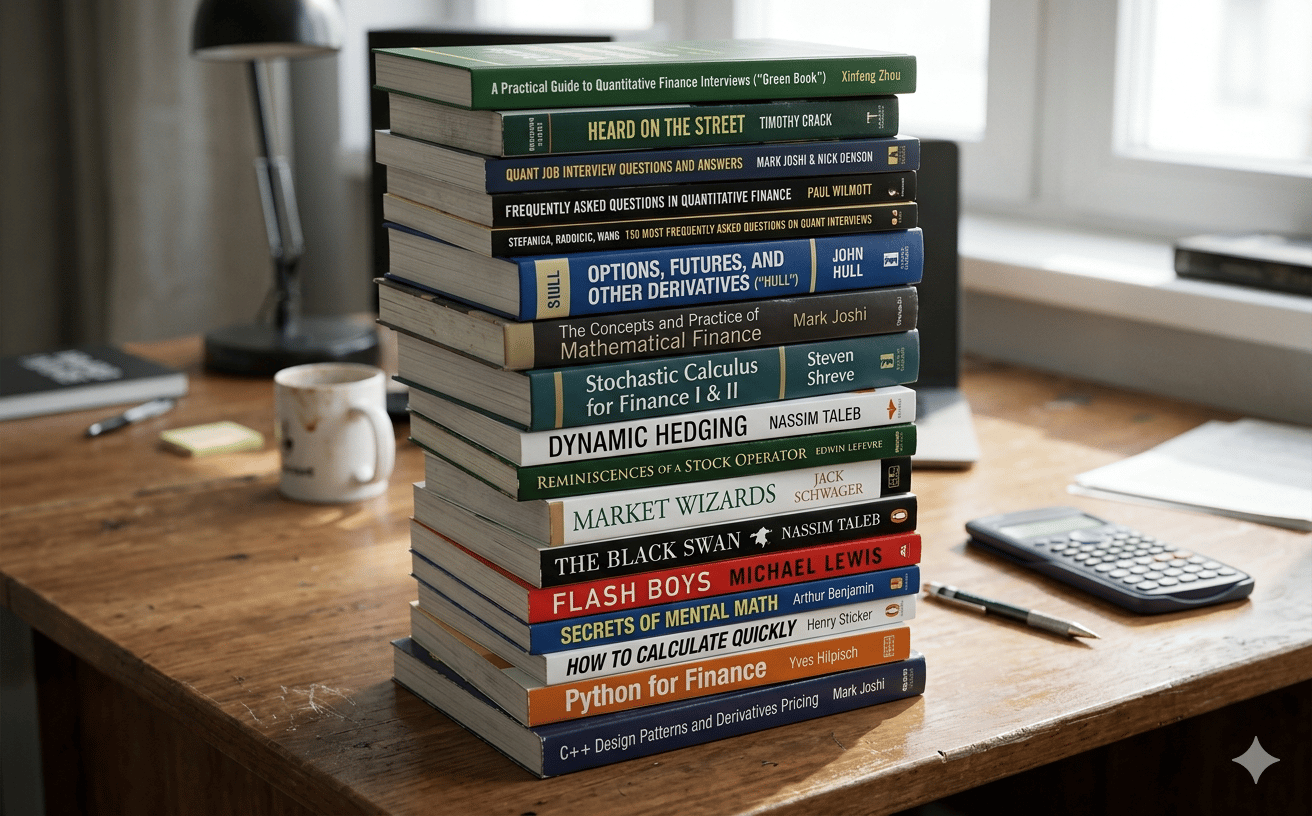
Quick-Reference Book Comparison Table
Use this table to find the right book for your situation at a glance. Books are sorted by category and include a difficulty rating (1 = accessible, 5 = advanced).
| Book | Author | Difficulty | Best For |
|---|---|---|---|
| A Practical Guide to Quantitative Finance Interviews ("Green Book") | Xinfeng Zhou | ★★★☆☆ | All quant/trading roles |
| Heard on the Street | Timothy Crack | ★★★☆☆ | All quant/trading roles |
| Quant Job Interview Questions and Answers | Mark Joshi & Nick Denson | ★★★★☆ | Quant researcher / developer |
| Frequently Asked Questions in Quantitative Finance | Paul Wilmott | ★★★☆☆ | Quant researcher / analyst |
| 150 Most Frequently Asked Questions on Quant Interviews | Stefanica, Radoicic, Wang | ★★★★☆ | Quant researcher / developer |
| Options, Futures, and Other Derivatives ("Hull") | John Hull | ★★★☆☆ | Options / derivatives roles |
| The Concepts and Practice of Mathematical Finance | Mark Joshi | ★★★★☆ | Quant researcher |
| Stochastic Calculus for Finance I & II | Steven Shreve | ★★★★★ | Quant researcher (math/physics) |
| Dynamic Hedging | Nassim Taleb | ★★★★☆ | Options traders |
| Reminiscences of a Stock Operator | Edwin Lefevre | ★☆☆☆☆ | All traders |
| Market Wizards | Jack Schwager | ★☆☆☆☆ | Discretionary / systematic traders |
| The Black Swan | Nassim Taleb | ★★☆☆☆ | All roles |
| Flash Boys | Michael Lewis | ★☆☆☆☆ | HFT / market-making roles |
| Secrets of Mental Math | Arthur Benjamin | ★★☆☆☆ | All trading roles |
| How to Calculate Quickly | Henry Sticker | ★★☆☆☆ | All trading roles |
| Python for Finance | Yves Hilpisch | ★★★☆☆ | Quant researcher / analyst |
| C++ Design Patterns and Derivatives Pricing | Mark Joshi | ★★★★★ | Quant developer |
Why Books Still Matter in 2026
Online platforms, practice tools, and mock tests are invaluable, but books offer something different: depth. A well-written book walks you through the reasoning behind a concept rather than just the formula or the answer. For quant and trading roles especially, interviewers probe your understanding, not just your ability to recall a result. Knowing why something holds, and being able to explain it clearly under pressure, is what separates strong candidates from exceptional ones.
The best preparation combines conceptual grounding from books with active, timed practice. Reading about probability theory is only useful if you can then solve expected value problems quickly, under pressure, without referring back to the book. Use the resources below to build your understanding, then reinforce it through focused practice on Tradermath's trainers and assessments.
Interview Preparation Books
These are the books most directly relevant to the quant and trading interview process. If you only have time for a small selection, start here.
1. A Practical Guide to Quantitative Finance Interviews — Xinfeng Zhou
Almost universally known as the "green book," this is the single most recommended resource for quant finance interviews. It covers probability puzzles, brain teasers, stochastic calculus, options theory, linear algebra, and statistics — all organized around the types of questions that actually appear in interviews. The problems are challenging and the solutions are clearly explained. Working through even the first few chapters will sharpen your probabilistic thinking considerably.
The green book is particularly relevant if you are interviewing at Jane Street, Citadel, Two Sigma, Hudson River Trading (HRT), or any firm with a research-oriented quant hiring process. The probability and brain teaser sections are the most commonly cited as directly useful.
Best for: Quant researcher and quant trader roles at top-tier firms.
Pair with: Tradermath's brainteaser practice to apply the concepts as found in the book.
2. Heard on the Street — Timothy Crack
Another interview staple, covering quantitative questions that appear throughout Wall Street and trading firm hiring processes. It includes probability, statistics, finance theory, and logic puzzles across five main sections. The breadth of questions makes it useful for early screening rounds and deeper technical interviews alike. Many interviewers have used this book directly as a source, knowing it well signals that you have done the fundamental preparation.
Heard on the Street is broadly applicable across firms but is particularly relevant for candidates interviewing at Goldman Sachs, Morgan Stanley, Barclays, and other investment banks alongside prop trading roles.
Best for: Anyone interviewing across a mix of trading and finance roles who wants comprehensive coverage.
Pair with: Tradermath's brainteasers section for additional problem practice.
3. Quant Job Interview Questions and Answers — Mark Joshi and Nick Denson
More technically demanding than the green book, this title targets candidates pursuing derivatives or model-focused quant roles. The questions are harder and require a stronger mathematical background, particularly in stochastic calculus and options pricing. It contains more than 200 questions not frequently seen in other books. If you are targeting roles where deep theoretical knowledge is tested, work through Xinfeng Zhou first, then use Joshi and Denson to push further.
Best for: Quant developer and quant researcher roles where derivatives knowledge is central.
Note: Has been noted for less polished formatting, but the content quality more than compensates.
4. Frequently Asked Questions in Quantitative Finance — Paul Wilmott
Wilmott's FAQ book is part reference guide and part interview preparation. It covers the key models, formulas, and debates in quantitative finance in a conversational format, and is particularly useful for understanding why certain models are used. That contextual knowledge is exactly what impresses in interviews. The book includes a dedicated section of interview questions with model answers and is a useful companion to the more problem-focused books above.
Best for: Candidates who want to understand the broader landscape of quantitative finance, not just solve specific problem types.
5. 150 Most Frequently Asked Questions on Quant Interviews — Dan Stefanica, Rados Radoicic, Tai-Ho Wang
A more recent addition to the standard reading list, this book focuses heavily on probability and stochastic calculus in a compact, pocket-guide format. It has been updated more recently than some of the older classics and reflects the evolution of technical questioning at top firms. For candidates targeting roles at firms like Citadel, Two Sigma, or DE Shaw, this book is a useful addition to the green book.
Best for: Quant researchers and financial engineers who want additional breadth on stochastic topics.
Quantitative Finance Foundations
Once your interview preparation is in place, these books will build the deeper conceptual understanding that distinguishes good candidates from exceptional ones, and that will serve you throughout your career.
Options, Futures, and Other Derivatives — John Hull
Known simply as "Hull," this is the standard textbook for derivatives and financial engineering. It covers options pricing, futures markets, interest rate derivatives, and risk management in rigorous but accessible terms. Most quant finance courses use this book, and its explanations of the Black-Scholes model, the Greeks, and hedging strategies are exceptionally clear.
If you are interviewing for any role at a firm that makes markets in derivatives: Optiver, IMC, Flow Traders, Susquehanna (SIG), or Citadel Securities, you should be comfortable with the core chapters of Hull. Many firms explicitly recommend it as background reading. The key chapters to prioritize are those on options pricing, the Greeks (delta, gamma, vega, theta), and volatility.
Best for: Any role involving options, derivatives, or financial engineering.
The Concepts and Practice of Mathematical Finance — Mark Joshi
This graduate-level text bridges the gap between pure mathematics and financial application. It covers martingales, Brownian motion, Ito calculus, and risk-neutral pricing in depth. It is demanding but rewards careful study. Candidates targeting senior quant roles at top firms will find this book useful for interview preparation as well as for the job itself.
Best for: Quant researchers and financial engineers with a strong mathematics background.
Stochastic Calculus for Finance I and II — Steven Shreve
Shreve's two-volume set is considered the definitive introduction to the mathematical foundations of quantitative finance. Volume I covers the binomial model and Volume II covers continuous-time models including the Black-Scholes framework. The writing is rigorous and the proofs are complete. If you want to truly understand the mathematics of derivatives pricing from first principles, this is the place to go.
Best for: Candidates with a mathematics or physics background pursuing research-oriented quant roles at firms like Jane Street, DE Shaw, or Renaissance Technologies.
Dynamic Hedging — Nassim Nicholas Taleb
Taleb's early technical work focuses on practical options trading rather than theory. It covers how traders actually manage and hedge options books, including tail risk, variance, and the real-world limitations of Black-Scholes. It is dense and opinionated, but there is a great deal of practical wisdom that textbooks do not provide. Reading this alongside Hull gives you both the clean theory and a healthy skepticism of its assumptions.
Best for: Options traders and anyone interested in the gap between textbook theory and live market practice.
Trading Classics and Market Insight
Not every useful book is a textbook. These titles give context, perspective, and narrative insight into how markets and trading firms actually work. They are worth reading to build motivation, to understand the industry you are entering, and to speak with fluency in interviews about markets, risk, and trading psychology.
Reminiscences of a Stock Operator — Edwin Lefèvre
First published in 1923, this is the fictionalized account of Jesse Livermore, one of the most legendary speculators in history. It remains one of the most widely read books in trading, not for specific techniques, but for its insight into market psychology, discipline, and the mental game of speculation. Many experienced traders return to it regularly. It is a short book and can be read in a weekend.
Best for: Anyone entering trading who wants to understand the human side of markets.
Market Wizards — Jack Schwager
Schwager's interview series covers some of the most successful traders in history, including Michael Marcus, Paul Tudor Jones, and Ed Seykota. Each interview explores the trader's philosophy, process, and approach to risk management. The diversity of strategies is striking, and the recurring themes, discipline, adaptability, respect for downside, are worth absorbing early in your career.
Best for: Discretionary and systematic traders who want perspective from practitioners across different markets and eras.
The Black Swan — Nassim Nicholas Taleb
A meditation on rare, high-impact events and how poorly most models account for them. This book is relevant to trading because it challenges the assumptions underlying standard risk models, particularly the reliance on normal distributions. It is not a how-to guide, but it permanently shapes how you think about probability and tail risk, which matters in any trading role.
Best for: All candidates; especially relevant before interviewing at firms like Optiver or IMC where risk intuition is tested.
Flash Boys — Michael Lewis
Covers the rise of high-frequency trading and the controversies surrounding it. It is narrative journalism rather than a technical manual, but it is informative about market microstructure, latency arbitrage, and the role of technology in modern markets. Candidates interviewing at HFT firms like Virtu, Hudson River Trading, or Jump Trading will benefit from the context it provides, even if some of its claims remain contested.
Best for: Candidates targeting HFT or electronic market-making firms.
Liar's Poker — Michael Lewis
Lewis's account of his time at Salomon Brothers in the 1980s captures enduring truths about the culture of trading floors: hierarchy, incentives, and the social dynamics of competitive environments. The landscape has changed dramatically since then, but the book remains one of the best introductions to the industry for outsiders.
Best for: Anyone new to the industry who wants cultural and historical context.
Mental Math and Numerical Thinking
Mental arithmetic speed and accuracy is tested at nearly every major trading firm. Optiver, Flow Traders, Akuna Capital, IMC, Maven Securities, and Da Vinci all include a timed mental math component early in their hiring process. The following books provide the techniques — but improvement ultimately comes from timed practice.
Secrets of Mental Math — Arthur Benjamin and Michael Shermer
Arthur Benjamin is a mathematician who has studied and taught mental calculation for decades. This book covers squaring numbers, multiplying multi-digit numbers, and other shortcuts that are directly applicable to the mental math rounds at trading firms. The techniques are clearly explained and learnable with focused practice.
Best for: Anyone preparing for the mental math screening rounds used by Optiver, Flow Traders, Akuna Capital, and IMC.
How to Calculate Quickly — Henry Sticker
An older but effective book focused on building automatic numerical fluency through structured exercises. Unlike books centered on tricks, this one builds genuine speed through repetition. It is particularly useful if your accuracy is strong but your pace is not where it needs to be.
Best for: Candidates who know the techniques but need to improve raw calculation speed.
Important note on practice: Reading about mental math techniques is only the beginning. Real improvement requires timed repetition. Tradermath's mental math trainers are built to mirror the exact formats used by specific firms.
Programming and Data for Quants
Most quant and systematic trading roles require programming ability, typically in Python, C++, or both. These books are strong starting points depending on your target role.
Python for Finance — Yves Hilpisch
This book applies Python to financial analysis, derivatives pricing, algorithmic trading, and portfolio optimization. The examples are practical and directly relevant to the work quants do. If you are learning Python in the context of finance, this is one of the clearest starting points available.
Best for: Quant researcher and quant analyst candidates targeting firms like Two Sigma, DE Shaw, or Citadel where Python proficiency is assessed.
C++ Design Patterns and Derivatives Pricing — Mark Joshi
For candidates targeting quant developer roles where C++ is the primary language, Joshi's book covers both the programming patterns used in derivatives pricing systems and the underlying financial mathematics. It is demanding and assumes both C++ knowledge and familiarity with derivatives theory. If you are aiming at a quant dev role at a major firm, working through this book is a meaningful advantage.
Best for: Quant developer candidates interviewing at firms like Optiver, IMC, or Citadel Securities where C++ proficiency is a core requirement.
Books by Firm and Role
Different firms test different things. Use this section to prioritize your reading based on where you are applying.
Flow Traders
Flow Traders uses timed mental math and sequence tests in their online screening. Prioritize: Secrets of Mental Math, How to Calculate Quickly, and the Flow Traders mental math trainer. Their sequence test is also a significant hurdle: practice with Tradermath's sequence trainer.
Akuna Capital
Akuna tests mental math, sequences and probability heavily. Prioritize: Secrets of Mental Math, the green book (probability sections), and the Akuna Capital math trainer.
IMC Trading
IMC interviews cover mental math, options theory, and market-making scenarios. Read our dedicated IMC interview guide, then prioritize: Hull and Secrets of Mental Math.
Jane Street
Jane Street is known for deep probability and expected value questions, as well as market-making games like Figgie. Prioritize: the green book (probability sections), Heard on the Street, and Tradermath's market-making game.
Susquehanna International Group (SIG)
SIG is famous for its game theory and decision-making questions. Prioritize: Heard on the Street, the green book, and Tradermath's Da Vinci / SIG online assessment trainer.
Maven Securities
Maven uses timed mental math, sequence tests and probability assessments in their online screening.
How to Use These Books Alongside Practice
Books and practice platforms work best together. Here is a simple framework for combining them effectively:
Start with interview prep, then go deeper. Begin with the green book and Heard on the Street to understand what is tested at the firms you are targeting. Once you have that foundation, the theoretical books: Hull, Joshi's mathematical finance text, Shreve, will feel purposeful rather than abstract.
Apply concepts immediately. When you read about probability puzzles or expected value problems in an interview prep book, go directly to Tradermath's brainteaser section and find problems of the same type. Solving a problem under mild time pressure shortly after reading the concept consolidates it far more effectively than reading alone.
Use mental math books as the start of a training cycle. Read a chapter of Secrets of Mental Math, practice the technique in isolation for a day or two, and then run timed sessions in the relevant Tradermath trainer. The feedback loop between technique and timed application is what produces measurable improvement.
Do not try to read everything at once. A focused effort on two or three books, completed properly with active problem solving alongside them, is more valuable than skimming ten books. Choose based on the role you are targeting and the gaps in your current knowledge.
Track your improvement. Tradermath's trainers track your accuracy and speed over time. Use them before and after working through a relevant book section to measure the actual impact.
Frequently Asked Questions
Is the green book enough to prepare for quant trading interviews?
The green book is the most important single resource, but it is not sufficient on its own for most competitive roles. At firms like Optiver and Flow Traders, mental math speed is tested separately and requires dedicated practice beyond book study. At firms like Jane Street or Citadel, the probability questions can go beyond what the green book covers. Use it as your foundation and build from there with firm-specific practice.
What is the difference between the green book and Heard on the Street?
Both are interview preparation books focused on quantitative questions, but they have different emphases. The green book (Xinfeng Zhou) is more focused on quant finance topics, stochastic calculus, options theory, and harder probability, and is better suited to quant researcher and quant trading roles. Heard on the Street (Timothy Crack) has broader coverage including statistics, financial economics, and non-quantitative questions, and is more applicable to a mix of finance and trading roles. Most serious candidates read both.
Do I need to read Hull before quant trading interviews?
For roles at market-making firms like Optiver, IMC, and Flow Traders, a working understanding of options and the Greeks is important and Hull is the standard reference for that material. You do not need to read all 900 pages. Focus on the chapters covering options basics, the Black-Scholes model, the Greeks, and hedging strategies. That subset is directly relevant to what is tested.
What should I read if I am targeting HFT roles specifically?
For HFT and electronic market-making roles at firms like Virtu, Hudson River Trading, Jump Trading, or Citadel Securities, prioritize mental math speed, C++ programming ability (for technical roles), and market microstructure knowledge. Flash Boys gives useful context. Secrets of Mental Math and How to Calculate Quickly are essential for the screening rounds. For technical quant developer roles, C++ Design Patterns and Derivatives Pricing by Joshi is the most relevant book-length resource.
Is the green book still relevant in 2026?
Yes. The core probability, brain teaser, and stochastic calculus content remains directly relevant because the fundamental skills being tested, logical reasoning, probabilistic thinking, and mathematical fluency, have not changed. The C++ sections are somewhat dated, as most firms now also accept or prefer Python, but the mathematical content is as applicable today as it was when the book was first published. Supplement it with Python skills for research roles and with firm-specific practice using tools like Tradermath.
What book should I read first if I am completely new to quant finance?
Start with Reminiscences of a Stock Operator to understand the human and psychological side of trading, then move to Heard on the Street and the green book for interview preparation. Alongside those, begin practicing mental math using Tradermath's Math Trainer. This gives you the conceptual foundation, the interview-specific preparation, and the applied numerical practice running in parallel.
How do books compare to online prep platforms?
They are complementary, not competing. Books provide conceptual depth and structured learning that is hard to replicate through practice questions alone. Online platforms like Tradermath provide the timed, adaptive, firm-specific practice that turns conceptual understanding into interview-ready performance. The strongest candidates use both: books for understanding, platforms for application and speed.
Do trading firms care whether you have read these books?
Firms do not ask whether you have read specific books. What they assess is whether you can solve the types of problems these books prepare you for, quickly, clearly, and under pressure. The books are the means; the ability is the end. That said, several firms have mentioned specific books in their preparation guidance, including Hull and the green book.
Final Thoughts
There is no shortage of material available to aspiring traders and quants, and it can be tempting to spend more time collecting resources than actually working through them. The books on this list have stood up over time and are directly relevant to the roles, interviews, and skills that matter most in quantitative trading and finance.
Choose a handful that match your current level and target firm, work through them seriously, and pair your reading with consistent timed practice. The combination of conceptual understanding and applied speed is exactly what trading firms are looking for. It is what separates candidates who know the material from candidates who can perform with it under the conditions of a real interview or a live market.
For firm-specific preparation, use Tradermath's trainers and assessments to put what you have learned into practice:
- Tradermath Math Trainer
- Tradermath Sequence Trainer
- Brainteasers and probability practice
- Market-making games
- Online assessment simulators
Good luck with your preparation!